

Best Nvidia & AMD GPU Settings for Mining: A Step-by-Step Guide

Disclaimer: This material is provided for general informational purposes only and does not constitute legal, tax, financial, or investment advice. It does not contain an offer to acquire, sell, exchange, use, or accept digital currency, nor is it intended to promote goods, works, or services related to the circulation of digital currency. Applicable regulation and legal consequences depend on the specific circumstances, a person's status, jurisdiction, the nature of the transaction, and other factors. Before taking any action, consult a qualified professional and check the current requirements of applicable law.
Mining is more than just generating cryptocurrency – it's an art. And like any craft, success depends on the right tools. When it comes to mining, your most valuable assets are high-quality, reliable GPUs from industry leaders like Nvidia and AMD. Configuring your graphics cards isn't just a technical detail – it's a meaningful factor in mining efficiency. Let's dive into the essential graphics card settings to get the most out of your hardware.
Before figuring out how to mine with AMD and Nvidia, it's important to understand the key concepts of the crypto world.
Cryptocurrency is a digital payment method that operates independently of banks or governments. It enables secure, decentralized transactions worldwide.
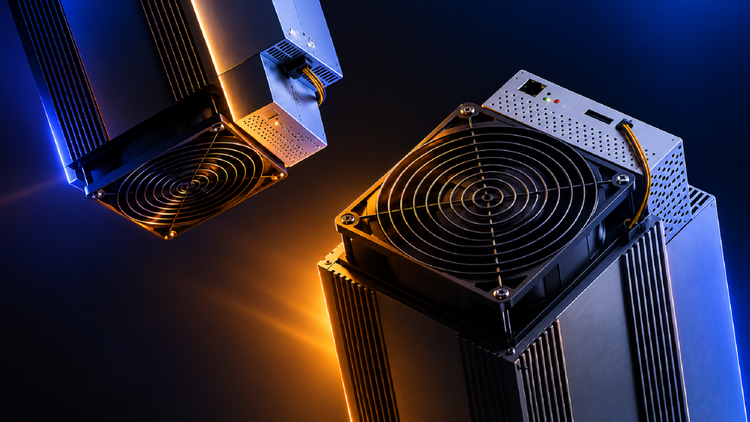
Mining Rig is a setup of computing devices working together to generate digital coins.
Key Takeaways
- There is no single “correct” overclock profile. Silicon quality varies chip to chip, even within the same model
- Generic AMD tuning numbers (memory clock, core voltage) not tied to your exact card model can be unstable or unsafe on your specific GPU
- Safe temperature ranges are model-specific, not universal
- Flashing a GPU's BIOS carries real risk of permanently disabling (“bricking”) the card if interrupted or done with the wrong firmware, and typically voids the manufacturer's warranty. It's not a routine step to take lightly
Four Types of Cryptocurrency Mining Rigs
CPU mining
This method involves using a computer's central processor – CPU – to mine cryptocurrency, often on a regular laptop. While it was once a viable option, increasing competition and rising hardware demands made CPU mining far less profitable for most coins. Today, standard laptops simply lack the computing power needed for efficient mining of most cryptocurrencies; a few CPU-friendly algorithms (like RandomX, used by Monero) remain a partial exception.
GPU mining
This method uses a high-performance PC or a dedicated mining rig with multiple graphics cards connected to the motherboard. GPUs offer significantly more parallel processing power than CPUs for the algorithms most altcoins use today, making this the practical middle ground between CPU and ASIC mining.
FPGA mining
An FPGA is a specialized electronic device that can be reconfigured to perform specific operations. Users can configure these devices to mine a particular cryptocurrency and later reprogram them for a different one if needed. FPGAs offer flexibility and efficiency but require advanced technical knowledge, making them more suitable for experienced miners.
ASIC mining
ASIC – Application-Specific Integrated Circuit – mining uses devices built for one purpose: mining a specific cryptocurrency's algorithm as efficiently as possible, which generally makes it the most power-efficient method for the coins it supports (mainly SHA-256 coins like Bitcoin).
ASIC miners are suitable for both solo miners and those running large mining farms. When scaling up, managing power consumption is crucial, since electricity costs have a direct impact on profitability.
To estimate potential earnings, use a live online calculator with your exact device specs and current network data — treat any output as a scenario tied to today's conditions, not a fixed prediction, since price and difficulty both change continuously.
Optimal GPU Settings for Mining
Step 1: Check All Essential Components
- Graphics card. The core of your mining rig. If using multiple GPUs, ensure they're properly configured together to avoid performance issues
- Motherboard. If connecting two or more GPUs, confirm your board supports multiple graphics cards and has sufficient PCIe slots
- Central processing unit. For GPU mining, a modest processor is generally sufficient, since mining relies primarily on GPU power rather than CPU performance. Match the CPU to your motherboard's actual socket and chipset requirements rather than a specific generation number, since compatible options change over time
- RAM. One of the key components for stable mining. 4GB to 8GB is a reasonable range for most GPU mining setups, though some algorithms and mining OSes have their own specific minimums
- SSD. A solid-state drive is a fast, reliable storage option; a USB flash drive can work for lighter setups, but an SSD is recommended for stability
- Cooling system. Mining generates significant heat, making effective cooling essential for preventing overheating and extending GPU and CPU lifespan
Step 2: Optimizing GPU Mining Settings
- Disable Windows notifications to avoid interruptions during mining
- Power settings: set sleep/display timeouts to Never so the PC stays in full performance mode
- Adjust Windows performance settings: use “Adjust for best performance” to prioritize system resources
- Virtual memory: set a custom paging file size (roughly 1.5-2x physical RAM) instead of automatic management, for more predictable performance
BIOS tuning can further help mining stability on some setups, but exact menu names and options vary significantly by motherboard manufacturer and model — there's no single universal BIOS walkthrough that applies across brands. Common adjustments some miners make include enabling 'Above 4G decoding' for multi-GPU support and adjusting PCIe link speed for stability over risers. Always check your specific motherboard's manual before changing BIOS settings, since disabling the wrong option can cause boot issues on some boards.
Step 3: Installing Mining Software
Choosing the right mining software matters as much as hardware tuning. For actual GPU mining today, common choices include T-Rex or NBMiner (Nvidia), TeamRedMiner or lolMiner (AMD), and GMiner, which supports both vendors across several algorithms including Etchash (used by Ethereum Classic).
As for operating systems, Windows, Linux, and HiveOS (a Linux-based mining OS) are the most common choices for crypto miners.
Windows
There's an ongoing debate over which Windows version works best for mining. Windows 10 generally supports more GPUs per rig and is the more common current choice; Windows 7 uses fewer system resources but has more limited multi-GPU support and — importantly — reached end of support from Microsoft in January 2020, meaning it no longer receives security updates. Running an unsupported, unpatched OS on an internet-connected mining rig carries real security risk regardless of its resource efficiency.
| Operating System | Pros | Cons |
|---|---|---|
| Windows 7 | Lower resource use, less system overhead | Limited multi-GPU support; unsupported by Microsoft since Jan 2020 — no security patches |
| Windows 10 | Supports more GPUs, suits larger rigs | Requires more setup expertise; higher resource overhead |
Linux
Linux has a strong reputation as a mining OS, with a lean, efficient interface. Its advantages include lower resource consumption (leaving more headroom for mining, especially on older hardware), and being free and open source. On older graphics cards, Linux mining tools can sometimes outperform Windows in hashrate, though this depends heavily on the specific driver and algorithm — it isn't a universal rule. On newer GPUs, the practical difference is often small or negligible.
HiveOS
HiveOS is a Linux-based mining operating system that provides remote monitoring and control for GPU rigs and supports both Nvidia and AMD hardware, including mixed-GPU configurations when the selected miners and drivers are compatible. HiveOS does not specify a fixed limit on the number of GPU cards per rig; the practical limit depends on the motherboard, PCIe configuration, drivers, power supply, and overall system stability.
Optimizing Nvidia Graphics Cards for Mining
Overclocking and tuning your Nvidia graphics card for mining aims to improve efficiency — mining more without needlessly shortening your hardware's lifespan.
Boosting video memory frequency is one of the most impactful changes for mining, since memory-bound algorithms rely heavily on it. This comes with tradeoffs:
- Higher power consumption. Overclocking memory increases power draw — monitor usage and confirm your PSU and circuit can handle it
- More heat. Without adequate cooling, this can cause thermal throttling or hardware stress over time
Ways to manage this: effective cooling (GPU fans, case airflow, quality thermal paste), and lowering the core clock somewhat while raising the memory clock, so the GPU's core isn't working as hard while memory does more of the useful work.
Undervolting — reducing voltage while maintaining stability — is a widely used technique for managing both power and heat in overclocked GPUs. It can help on many cards, not just one specific model, though the exact voltage a given chip tolerates varies.
Configuring AMD Graphics Cards for Mining
AMD GPU tuning differs from Nvidia's process in a meaningful way: on many AMD cards, mining performance can be optimized without flashing the BIOS at all, which is simpler and lower-risk than Nvidia's BIOS-dependent tuning path for some models. AMD mining enthusiasts often use Linux for fine-tuning.
Many Nvidia GPUs from the RTX 3000 series originally shipped with an LHR (Lite Hash Rate) limiter designed to reduce their appeal to miners.
In the fall of 2022, Nvidia's 522.25 driver removed LHR limitations for most RTX 3000 series cards — though notably, the RTX 3050 and the 12GB RTX 3080 were reported as exceptions that didn't reach full unlock even through later third-party tools. With Ethereum no longer mineable since its move to Proof-of-Stake in September 2022, LHR is largely a legacy consideration today, relevant mainly to Etchash-based mining (Ethereum Classic) rather than the coin LHR originally targeted.
Overclocking Guide for Nvidia Graphics Cards
Even a mining beginner can learn the basics of GPU overclocking. Keep in mind: there's no single “perfect” settings profile — results vary even between identical GPU models, since individual chip quality differs.
The general goal is pushing the GPU toward its practical performance ceiling while keeping operation stable. If stability drops at any step, back off that change before moving to the next parameter. The general process:
- Set fan speed
- Overclock memory
- Adjust power limit
- Adjust core clock
1. Fan Speed
A common starting point is setting fans to a fixed 75-85% (rather than 'exactly 80%') and observing temperatures, then adjusting from there — lower or back to auto if your GPU stays comfortably within its safe range.
Always check your card's actual maximum allowable temperature (from the manufacturer or monitoring software already on your system) rather than assuming a fixed number applies to your specific model.
When monitoring temperature, pay attention to the hotspot ('junction') temperature specifically — this is typically the hottest point on the die and, on many cards, isn't the same figure as the headline core temperature reported by default. Room temperature also affects your results significantly between seasons.
2. Memory Overclocking
Start by gradually increasing the memory clock, then adjust in small increments while watching for stability. As one illustrative example (not a target for your card): a particular RTX 3050 unit tested at stock ran a 1987 MHz core / 6800 MHz memory clock at roughly 25 MH/s, and after gradual tuning reached roughly 7950 MHz memory (+1150 MHz) and about 30 MH/s. Your own card's ceiling will depend on its individual silicon — push in small steps and stop increasing once you see instability (errors, crashes, or a hashrate that stops improving), rather than copying this specific number.
The performance gain from overclocking varies even between identical GPU models — results depend on individual chip quality, cooling, and overall system configuration.
3. Power Limit
Reducing power limit is a common step for improving efficiency — it lowers stress on the PSU and GPU, cuts energy cost, and helps control temperature. A typical approach is decreasing the power limit gradually and watching for the point where hashrate starts dropping meaningfully — that point (not a fixed percentage) is your practical floor. Exactly where that point lands varies by card and even by unit; treat any specific percentage as an example, not a target.
4. Core Clock
A common approach is starting near stock (0 MHz offset) and adjusting in small negative increments, checking hashrate after each change and stopping once it starts dropping — this keeps the core from working harder than the workload needs, which helps with heat and stability.
Voltage Curve (Undervolting)
Undervolting aims to find the lowest voltage at which your specific GPU stays stable while mining efficiently. Default voltage varies by card and manufacturer — commonly in a broad range depending on the model — but manufacturers generally build in a safety margin, meaning many chips can run stably somewhat below their factory default. There's no single number that applies to every GPU; find your own card's stable floor through gradual testing rather than targeting a specific voltage figure from an unrelated card.
General process in most tuning software: hold Shift and click a point on the voltage-frequency curve, then drag it down to reduce voltage at that frequency point while checking that performance holds. After adjusting, close the curve editor, apply settings, launch your mining software, and monitor stability for several minutes before making further changes. If stable, you can try lowering further in small steps until hashrate starts to drop — that's your practical floor for that specific chip.
Illustrative Before/After Example
The figures below describe one specific RTX 3050 unit's results after tuning — useful as an illustration of the kind of gains tuning can produce, not as numbers to replicate on a different card:
- Memory overclock: +1150 MHz (example unit)
- Hashrate change: roughly 25 to 30 MH/s (+20%, example unit)
- Power draw: reduced (example unit)
- Core clock: reduced from stock (example unit)
- Voltage: reduced from stock (example unit)
Optimizing AMD GPUs for Mining
AMD GPU tuning follows the same general principles as Nvidia — adjust memory clock, core clock, and voltage gradually while watching stability — but the exact numbers depend entirely on your specific card model and even the individual chip. There's no single set of values (memory clock, core frequency, voltage in mV) that applies safely across AMD's GPU lineup, so treat any specific figure you find online as a starting reference for that exact card — not a universal recipe.
Third-party tuning tools exist for AMD GPUs, alongside AMD's own official software, which many 'red team' miners prefer for stability.
GPU Cooling for Mining
Recommended operating temperatures vary significantly by GPU model and generation, so there is no single limit that applies universally. As a rough reference, many Nvidia RTX 30-series cards operate with core temperatures below roughly 90–93°C under sustained load, while hotspot temperatures may be higher. Many newer AMD RX 7000-series cards support higher junction temperatures, often around 95–105°C, while edge temperatures are typically kept lower. Always check the specifications for the exact GPU model rather than relying on a single temperature target for all Nvidia or AMD cards.
Ways to manage temperature include replacing thermal paste when temperatures begin rising over time, cleaning dust carefully, maintaining sufficient airflow, repositioning or upgrading fans, and considering an open-frame setup or liquid cooling for more demanding configurations. A stable, well-tested driver version can also help avoid performance issues unrelated to cooling.
GPU tuning should be approached gradually, with conservative changes to power limits, clock speeds, and fan settings rather than copying another rig’s configuration. For rigs connected to EMCD Mining Pool, 24/7 hashrate and worker monitoring provides an additional operational reference: unexpected changes in pool-side hashrate can help indicate when a GPU or worker is no longer performing as expected.
FAQ
How do I choose a graphics card for mining?
Look beyond raw power alone: hashrate for the specific algorithm you plan to mine, power draw and your local electricity cost, purchase price, and VRAM size all factor into real-world profitability. A higher-power card isn't automatically more profitable once you account for its higher electricity cost and purchase price — run the numbers for your specific situation with a live calculator.
Which graphics cards are suitable for mining?
Both AMD and Nvidia produce GPUs suitable for mining various algorithms; the better fit for a specific coin depends on that algorithm's hardware requirements (memory bandwidth, compute type) more than brand alone.
What does GPU BIOS flashing for mining mean?
Flashing a GPU's BIOS means replacing its firmware, sometimes to unlock additional power limit headroom, adjust fan curves, or fix specific known issues. This carries real risk: an interrupted flash, or flashing firmware not matched to your exact card revision, can permanently disable ('brick') the GPU, and manufacturers generally consider a modified BIOS to void the warranty. Only flash a BIOS you've sourced from a verified, card-specific source, and only if you understand the recovery process in case something goes wrong.
Which CPU should I choose for GPU mining?
For pure GPU mining, CPU choice matters mainly for motherboard/socket compatibility and having enough PCIe lanes for your GPU count — raw CPU performance is a low priority since the GPUs do the actual mining work.
Disclaimer: This material is provided for general informational purposes only and does not constitute legal, tax, financial, or investment advice. It does not contain an offer to acquire, sell, exchange, use, or accept digital currency, nor is it intended to promote goods, works, or services related to the circulation of digital currency. Applicable regulation and legal consequences depend on the specific circumstances, a person's status, jurisdiction, the nature of the transaction, and other factors. Before taking any action, consult a qualified professional and check the current requirements of applicable law.
without growing costs
cryptocurrencies