

How to Mine Canxium

Cryptocurrencies attract users with decentralization and the potential to earn through mining — the process that generates new blocks, validates transactions, and rewards participants with newly minted coins and a share of transaction fees.
Mining the largest coins like Bitcoin requires expensive, power-hungry equipment, so newer coins can be more accessible to beginners. This guide explains what Canxium (CAU) is and how it is actually mined — which, importantly, is through cross-chain mining with Kaspa, not on its own.
Key Takeaways
- Canxium (CAU) is not mined on its own algorithm in practice — it is earned through cross-chain mining with Kaspa: you mine Kaspa (kHeavyHash) as normal, and by tagging your Kaspa block with your Canxium address, you also receive CAU for that block
- This means the hardware that matters is a Kaspa ASIC (kHeavyHash) — not an “Ethereum ASIC.” Ethereum can no longer be mined at all (it moved to Proof-of-Stake in 2022), so any Ethash device is obsolete
- CAU uses a dynamic Proof-of-Demand emission model, so block rewards rise and fall with market demand — which makes its economics unusually volatile and hard to predict
- Whether CAU mining pays anything depends entirely on the CAU and KAS prices, difficulty, and your electricity cost — verify with a live calculator; do not rely on any fixed weekly-income figure
What Is Canxium and What Makes It Unique
Canxium (CAU) is a decentralized cryptocurrency created by an anonymous developer known as Neo Krypt. It launched in March 2023 through a “fair launch” — no ICO and no developer pre-mine, so every miner started on equal terms. Its distinctive features include:
- Dynamic emission via Proof of Demand (PoD). Unlike coins with a fixed emission schedule, CAU adjusts block rewards in response to market demand: when buy pressure rises, rewards adjust upward, attracting miners; when demand falls, issuance slows. Note that Canxium is not a stablecoin — it is not pegged to any currency and does not use token burning
- Hybrid consensus (in transition). The network has combined Proof of Work, Proof of Demand, and Proof of Stake, with stakers validating transactions without a reward for doing so. Note: the project's own roadmap states that in 2026 this three-way hybrid model was retired in favor of "PoW 2.0" — a new Cooperative Consensus Protocol that returns Canxium to a pure Proof-of-Work design, where pools cooperate to seal a single block instead of competing over separate block templates. Public sources are inconsistent on whether this transition is fully complete or still rolling out, so confirm the network's current consensus mechanism directly with the project before relying on the hybrid-model description here.
- Retained Proof of Work (RPoW). CAU can be mined without a constant internet connection: the miner performs local computations and periodically submits the results to the Canxium network
- Cross-chain mining with Kaspa. This is how CAU is earned in practice. A miner mines Kaspa (kHeavyHash) and appends a Canxium tag (canxiuminer:
) to the Kaspa block’s coinbase payload; every valid Kaspa block then also credits CAU to that address. Kaspa was the first chain supported for cross-chain mining, and remains the primary one in practice — but the project has since begun expanding to other PoW chains (Ravencoin/KawPoW support has been announced, with Ethereum Classic, Bitcoin, and others listed in the roadmap). Verify current chain support directly with the project before setting up, since this changes as the ecosystem develops. - Fast transactions. Average confirmation time is around 6 seconds.
Why Canxium Mining Draws Interest
Canxium was designed with miner-friendly conditions in mind. Key points miners cite:
- Fair-launch, PoW-only rewards — all rewards are issued through Proof of Work, so miners start on equal footing regardless of the network's validation layer (see the note above on Canxium's consensus model, which may be transitioning away from staking-based validation).
- Retained PoW support — a temporary loss of internet connection does not lose your work; results can be submitted once the connection returns.
- Cross-mining with Kaspa — you mine Kaspa and receive CAU on the same blocks, so CAU is additional yield on a Kaspa operation rather than a standalone activity.
- Proof-of-Demand dynamics — block rewards rise when demand for CAU rises. This cuts both ways: rewards also fall sharply when demand drops, which makes CAU income more volatile than fixed-emission coins, not more stable
What Hardware Do You Need to Mine Canxium
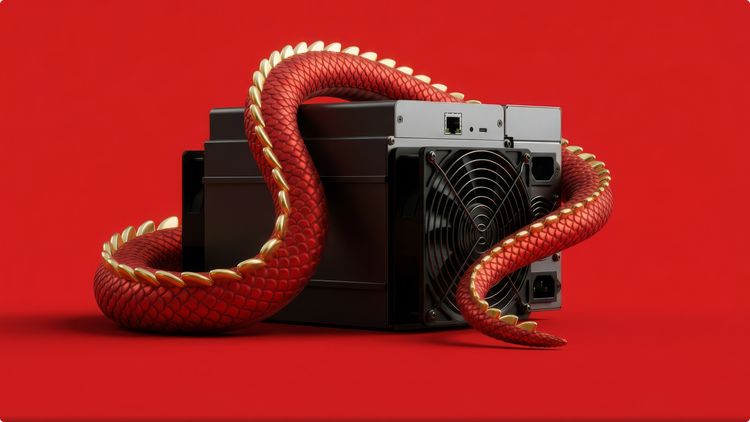
For cross-chain mining with Kaspa, you need an ASIC built for the kHeavyHash algorithm. There is no separate Canxium miner: compatible hardware mines KAS, while a pool with Canxium support uses the same work to generate additional CAU rewards.
EMCD Mining Pool provides quick setup, continuous monitoring, live support, and individual terms for larger miners.
Before connecting, confirm the pool’s current CAU payout requirements and supported addresses. Before buying hardware, compare hashrate, wall power, efficiency, voltage, noise, price, and current network conditions using official specifications and a live mining calculator.
Setting Up CAU Cross-Chain Mining
The practical setup is a Kaspa mining setup with your Canxium address attached. Most Kaspa ASICs (IceRiver KS and Antminer KS series) ship with kHeavyHash firmware already installed. In the ASIC settings, enter your chosen pool’s address and your wallet addresses for both Kaspa and Canxium. If your pool supports KAS+CAU cross-mining, it appends the required Canxium tag to the Kaspa block for you — you simply provide a valid CAU address.
To manage several ASICs at once, tools like Awesome Miner or Minerstat ASIC Hub let you configure pool and wallet details across devices from one PC on the same local network.
CAU Mining Profitability
Standalone CAU mining earns very little at the coin’s low market value — which is why cross-mining with Kaspa is the standard approach: the bulk of your financial result comes from KAS, with CAU as an added reward on the same work. Actual earnings depend on the KAS and CAU prices, network difficulty, and your electricity rate, so estimate them with a live calculator for your exact ASIC and today’s data rather than any fixed figure.
Factors that affect your financial result:
- CAU market price — under Proof of Demand this matters doubly: a higher price both raises the coin’s value and increases the block reward, while a lower price cuts both
- Electricity cost — the single biggest lever on net profit
- Correct hardware and software configuration — CAU’s network has unique features and does not work well with generic firmware or default settings
- Pool fees — higher fees reduce net income
- Because of the PoD mechanism, network difficulty has less direct impact on CAU earnings than on typical coins
Common Issues and Challenges
Setting up Retained PoW mining can run into hardware or software incompatibilities with Canxium’s unique network parameters — for example, outdated DAG files or incorrect time settings can cause improper block generation, and wallet synchronization or block submission can be tricky in isolated environments without stable connectivity.
Cross-mining adds its own challenges: not all ASICs and mining software allocate resources cleanly across the setup, which can reduce efficiency. Canxium mining is also sensitive to overheating and unstable power. Ensure proper ventilation, a stable power supply, and correct configuration.
Withdrawing CAU
CAU can be converted on several exchanges — keeping in mind that funds held on any exchange carry platform risk and are not suited for long-term storage.
Basic safety rules apply: never share your private key or seed phrase; keep offline backups; use only official apps; double-check recipient addresses; enable 2FA on exchange accounts; avoid public Wi-Fi for wallet access; and keep large amounts in cold storage.
Canxium’s Prospects
Canxium launched to notable interest for its Retained PoW concept and hybrid consensus. Its price history has been highly volatile — an early rise followed by a long decline — which is a caution, not a forecast: past price movements do not indicate future value.
For miners, the practical takeaway is that standalone CAU mining is not economical, while cross-mining alongside Kaspa lets you participate in the Canxium ecosystem as added yield on a Kaspa operation. Whether that is worthwhile depends on current KAS and CAU economics — check them before committing.
FAQ
What’s the best hardware for mining Canxium — ASIC or GPU?
A kHeavyHash Kaspa ASIC. CAU is earned by cross-mining with Kaspa, so a Kaspa ASIC (IceRiver KS or Antminer KS series) lets you mine KAS and receive CAU on the same blocks. Standalone GPU mining of CAU is not economical.
How much can you earn mining Canxium?
There is no fixed figure. Standalone CAU earns very little; cross-mining with Kaspa means most of your income is KAS, with CAU added on top. Run your exact ASIC and electricity rate through a live calculator with today’s prices.
Can you mine Canxium on Windows or only Linux?
Management tools like Awesome Miner and Minerstat ASIC Hub run on both Windows and Linux, so the operating system is not a limitation for a cross-mining setup.
How do I secure my CAU wallet?
Never share private keys or seed phrases; keep offline backups; use only official apps from trusted sources; enable 2FA on any exchange account; and avoid accessing your wallet over public Wi-Fi.
without growing costs
cryptocurrencies