

Heating Homes and Greenhouses with Mining: How to Use the Heat Generated by Mining Equipment


Cryptocurrency mining is no longer viewed solely as a way to earn digital assets. Modern mining hardware consumes large amounts of electricity, and nearly all of that energy is converted into heat that can be used to warm residential and utility buildings.
Today, more mining equipment owners view home heating with mining hardware as a way to improve electricity efficiency during colder months. Rather than venting heat outdoors, it can be redirected to heat a house, garage, underfloor heating system, greenhouse, or workshop.
It is important to understand that a miner does not generate heat for free. It converts electrical energy drawn from the grid into usable thermal energy. The economic benefit comes from the ability to heat a building while simultaneously generating mining revenue.
Key Takeaways
- Virtually all electricity consumed by mining equipment is eventually converted into heat. Therefore, ASIC miners can be used not only for cryptocurrency mining but also for space heating.
- Residential buildings typically use Hydro ASIC systems connected through a water loop. Heat is transferred to a boiler, radiators, or an underfloor heating system.
- Garages, warehouses, and greenhouses often use a simpler setup in which heated air is delivered directly from the equipment through air ducts.
- Recovering heat generated by mining equipment helps reduce heating costs during winter while allowing the hardware to continue operating for its primary purpose.
- A miner used for heating still needs a pool: connected to EMCD Mining Pool, it receives regular BTC payouts while its heat warms your home or utility building.
- Heating with a miner is about as efficient as an ordinary electric heater, but less efficient than a heat pump. The economic benefit comes from mining revenue, not from the heat itself.
- Before installing, check the electrical load, fire safety, noise, and humidity, and keep a backup heat source in case the miner stops.
Why Almost All Energy Consumed by an ASIC Miner Turns into Heat
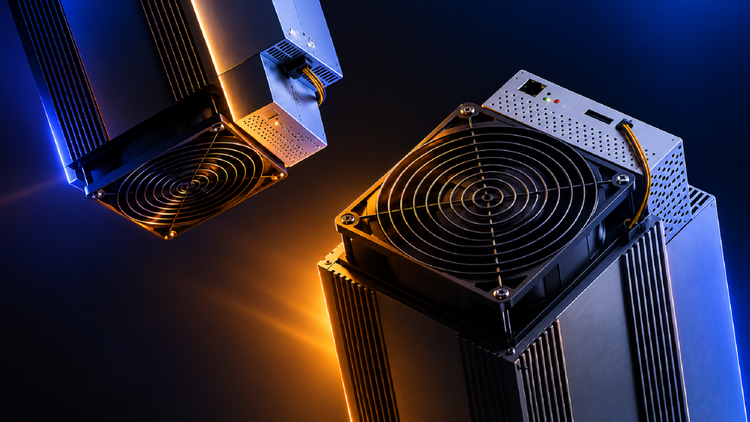
Modern ASIC miners perform an enormous number of calculations. During operation, nearly all of the electrical energy they consume is converted into thermal energy.
For this reason, mining equipment effectively functions as an electric heater. The difference is that a conventional heater only produces heat, whereas an ASIC miner used for home heating simultaneously participates in cryptocurrency mining.
This is why heating a house with an ASIC miner continues to attract growing interest among homeowners. It provides both a source of heat and an opportunity to generate mining revenue, provided that network profitability and electricity costs make mining economically viable.
The effect is particularly noticeable during winter, when heating demand reaches its peak. At that time, heat generated by the equipment can be used most efficiently.
Water-Based Heating Using Hydro ASIC Miners
One of the most promising approaches is the use of mining equipment equipped with liquid cooling systems.
Hydro ASIC models transfer heat not directly into the air but into a circulating coolant. The heated coolant then passes through a water-to-water heat exchanger, transferring thermal energy to the building's heating system. As a result, systems built around an ASIC water heat exchanger make it possible to integrate mining equipment into existing heating infrastructure.
The heated water can be used to supply radiators, a hot water storage tank, or an underfloor heating system. However, connecting mining equipment to a residential heating system requires a properly designed engineering solution.
A typical Hydro ASIC boiler system operates as follows:
- Hydro mining equipment heats the coolant
- A water heat exchanger transfers the heat to the building's heating circuit
- A boiler or storage tank accumulates a reserve of hot water
- Heat is distributed throughout the premises
A modern Hydro ASIC miner typically produces several kilowatts of thermal power. In a well-insulated building, this may be enough to heat part of a house, a small home, a garage, a workshop, or a greenhouse. When several devices are used together, their combined heating capacity can reach tens of kilowatts.
Keep in mind that the miner produces heat only while it is running. If it stops because of a failure, a power outage, or because mining has become unprofitable, the building loses its heat source. That is why a residential system should always include a backup heater or boiler and automation that switches it on when the coolant temperature drops.
An underfloor heating system powered by an ASIC miner can also be implemented. This solution provides a more uniform temperature distribution throughout the building and improves overall comfort.
Another advantage of Hydro systems is lower noise output compared to conventional air-cooled mining solutions.
Today, ready-made kits are available on the market that include a boiler, heat exchanger, automation components, and other system elements.
Air Heating for Garages, Warehouses, and Greenhouses
Creating a complex water-based heating circuit is not always necessary. For utility buildings and agricultural facilities, it is often sufficient to use the generated heat directly.
In such systems, air ducts or flexible ventilation tubing are connected to the mining equipment to deliver heated air to the target area.
This approach is commonly used to implement air heating in a garage using ASIC miners. Such a solution is relatively simple to install and comparatively inexpensive.
The following components are typically used in this type of system:
- Air ducts or flexible ventilation hoses
- Ventilation grilles
- Air filtration systems
- Temperature monitoring and control devices
These air-based heating solutions are suitable for garages, warehouses, workshops, utility rooms, and greenhouses.
For greenhouses, this approach is especially attractive during winter. Warm air helps maintain a stable microclimate while reducing heating costs.
But greenhouses have high humidity, which is dangerous for ASICs: condensation and moisture damage the boards. That is why the equipment is usually placed in a separate dry room or container next to the greenhouse, and only warm air is ducted inside, through filters.
When designing such a system, it is important to ensure proper airflow distribution. Air should not be directed directly at plants or equipment. Instead, airflow should be distributed evenly throughout the space.
This allows the heat generated by mining hardware to be utilized as efficiently as possible while avoiding the risk of localized overheating.
Dual Benefits: Heating and Mining at the Same Time
The main advantage of this approach is that the same energy serves two purposes simultaneously.
Under normal circumstances, electricity expenses are allocated entirely to heating. With mining, part of these expenses can be offset by income generated from cryptocurrency mining.
For this reason, many homeowners view ASIC-based heating as an additional way to improve energy efficiency.
The process works as follows:
- The equipment operates and performs computational tasks.
- During winter, the heat it generates is used for space heating.
- Mining generates additional revenue.
- Mining rewards are transferred to a cryptocurrency wallet.
This approach is particularly attractive for homeowners in regions with long heating seasons.
At the same time, seasonality should be taken into account. While the generated heat can be used efficiently during winter, in summer it usually has to be dissipated outdoors or used for other purposes, such as heating water. In summer, the economics also change: without heating demand, the miner competes only on mining revenue, so some owners reduce its power or switch it off during the warm season. The more of the year the heat is actually used, the better the overall economics of the setup.
The Real Economics: How a Miner Compares with Other Heaters
A miner turns almost all of the electricity it consumes into heat, so in terms of heat output it is equivalent to an ordinary electric heater: a 3 kW miner heats about as much as a 3 kW electric heater. The difference is that the miner also earns mining rewards.
But it is important to compare correctly:
- compared with an electric heater, a miner wins: the heat is the same, and mining revenue partly or fully offsets the electricity bill;
- compared with a heat pump, the picture is different. A heat pump delivers several kilowatts of heat for each kilowatt of electricity, so it can heat a building with noticeably less electricity. A miner wins only if its mining revenue covers the difference;
- compared with gas heating, it depends on local gas and electricity prices.
The final result depends on:
- the price of electricity;
- the current price of BTC and network difficulty;
- the efficiency of the equipment;
- how much of the heat you actually use.
Calculate the payback for your conditions before buying, and account for the fact that mining revenue can fall due to market movements.
Safety First
A miner used for heating is a powerful electrical appliance that runs around the clock. Before installing it:
- check the electrical wiring. A single miner can draw several kilowatts continuously, which household circuits are often not designed for. You may need a dedicated circuit, suitable cable cross-section, and proper protective devices installed by a qualified electrician;
- ensure fire safety: do not place equipment near flammable materials, keep ventilation openings clear, and install a smoke detector;
- take noise into account: air-cooled miners are loud and are better installed in a garage or utility room than in living spaces. Hydro models are much quieter;
- control humidity and dust, which shorten the life of the equipment;
- check the rules: some regions have restrictions on residential mining or require permits for changes to the heating system, and mining income may be taxable.
Key Considerations Before Implementing the System
Before adopting such a solution, several factors should be evaluated.
First, it is necessary to determine the actual heat losses of the building. This will define how much equipment is required to provide sufficient heating.
Second, it is important to choose an appropriate heat transfer method in advance: water-based or air-based.
Third, ventilation requirements, noise levels, and equipment placement should also be considered.
For residential properties, a water loop connected through a heat exchanger and storage tank is usually the better choice, while outbuildings and utility structures can often use simpler air-based systems.
It is also important to remember that ASIC mining equipment requires stable power, regular maintenance, and continuous monitoring of operating conditions.
Connecting to a Pool and Monitoring the System
To earn revenue, the miner is connected to a pool, for example EMCD Mining Pool, which combines the hashrate of participants and distributes rewards in proportion to their contribution. Payouts arrive in BTC at the wallet address set in your account settings.
When a miner heats a building, its uptime affects not only revenue but also the temperature in the house. That is why it is important to see what is happening with the equipment at all times. EMCD Monitoring shows hashrate, chip temperature, and fan speed, and alerts you immediately if a device goes offline or overheats, so you can switch on the backup heating in time. It works with any pool and firmware.
Conclusion
Using mining equipment for heating applications is becoming increasingly popular. The reason is simple: almost all of the energy consumed by ASIC miners is converted into useful heat.
For residential properties, Hydro-based systems connected through a water loop, storage tank, and heat exchanger are often the most suitable option. For garages, warehouses, and greenhouses, air-based heat distribution is frequently sufficient.
As a result, two benefits are gained simultaneously: a source of heat and potential mining revenue. This is why miner heat recovery is gradually evolving from an unconventional concept into a fully developed engineering solution for modern homes and commercial or agricultural facilities.
FAQ
Can mining completely replace a boiler?
In some cases, yes. It depends on the size of the building, its insulation, and the capacity of the equipment. But it is safer to keep a backup heat source: if the miner stops because of a failure, a power outage, or a drop in profitability, the building should not be left without heat.
How efficient is heating with a miner?
Almost all of the electricity is converted into heat, so a miner is about as efficient as an ordinary electric heater. A heat pump is more efficient per kilowatt of electricity. The benefit of a miner comes from mining revenue, which partly or fully offsets the cost of electricity.
Is this solution suitable for greenhouses?
Yes. Many greenhouse owners use the heat generated by mining equipment to maintain temperatures during cold periods.
Which option is better: Hydro or an air-based system?
For residential buildings, a water-based solution is usually the better choice. For garages, warehouses, and greenhouses, direct distribution of warm air is often sufficient.
Can a single miner heat an entire house?
It depends on the size of the house and the quality of its insulation. For small, well-insulated buildings, one unit may be enough, but there is no universal solution.
without growing costs
cryptocurrencies