Merged Mining Explained: Parallel Rewards on the Same Algorithm
Most new miners don’t realize that their hardware can deliver more without any extra setup or configuration. Merged mining unlocks this hidden potential: the ability to mine two coins simultaneously using the same computational work, increasing overall rewards.
This article explains what merged mining is, how it works on a technical level, and why it has become one of the most accessible and effective ways to improve mining efficiency.
What Is Merged Mining and How Does It Work
Mining is the process of performing mathematical calculations to validate transactions and create new blocks. In Proof-of-Work (PoW) networks, miners are for this computing effort, while the blockchain remains secure thanks to the collective hashrate of its participants.
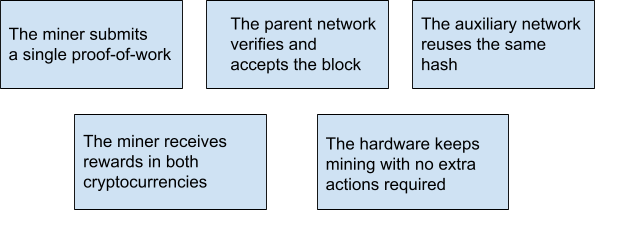
Merged mining is a method that allows the same proof-of-work to be accepted by two blockchains. A miner completes a single computational task, which is then verified by both parent and auxiliary networks. When both verifications succeed, rewards are issued from each network.
This process relies on Auxiliary Proof-of-Work (AuxPoW), a protocol enabling the auxiliary blockchain to trust the proof provided to the parent chain. To function correctly, both chains must use the same hashing algorithm.
For example, EMCD Pool supports merged mining between compatible networks:
- Bitcoin → Fractal
- Kaspa → CAU
- Litecoin → Dogecoin, BEL, LKY, DINGO, PEP, JKC
When the algorithm matches and AuxPoW is supported, mining proceeds as usual. The pool handles merged mining automatically, sending coins from both networks to the miner — with no additional configuration required.
This setup allows miners to maximize computational power, increasing potential income without extra energy consumption or hardware.
What It Looks Like in Practice
Merged Mining vs. Dual Mining: What’s the Difference
Merged mining is often confused with dual mining, especially by beginners. While both involve earning rewards from more than one coin, the underlying mechanisms are fundamentally different.
Dual mining uses a GPU to mine two different cryptocurrencies on two separate algorithms at the same time. This method usually requires custom configuration, increased energy consumption, and puts additional strain on the hardware. It is mostly used in GPU-based mining environments.
Merged mining, on the other hand, uses a single hashing algorithm and a shared stream of computational work. Both blockchains validate the same PoW hash in parallel, allowing miners to receive rewards from two networks without increasing workload or power usage.
Here’s a comparison of the two approaches:
| Aspect | Merged Mining | Dual Mining |
| Algorithms | Single, shared hashing algorithm | Two different algorithms |
| Configuration | Automatic, handled by pool | Manual configuration and tuning required |
| Power Consumption | Same as single-coin mining | Higher energy use and heat generation |
| Hardware | Works with ASICs and GPUs (depending on network) | Mostly GPU-based |
| Extra Coin Setup | Automatic | Must be configured separately |
| Stability | High stability, minimal risk | Higher risk of overheating or instability |
| Best For | Beginners and efficient mining | Experienced users seeking custom configurations |
In simple terms:
- Dual mining = two algorithms, more energy, more setup
- Merged mining = one algorithm, one job, two rewards
For miners seeking higher returns without technical complexity, merged mining offers a more stable and beginner-friendly alternative. On EMCD Pool, the process is seamless: compatible chains are merged and rewards are distributed automatically, making it easy even for those new to mining.
Why Merged Mining Maximizes Income
Merged mining increases profitability by efficiently using computational power. The mining process remains unchanged, but as the output grows, rewards are generated from more than one blockchain without adding additional stress on the hardware.
Another key advantage is simplicity. There’s no need to switch algorithms, monitor multiple coins manually, or adjust configurations. The secondary coin is credited automatically, with no interference in the main mining process.
This ease of use lowers the chances of error and helps beginners avoid the technical hurdles typically associated with increasing mining returns. Interest in merged mining continues to grow for a reason: it offers a consistent way to boost earnings without expanding equipment or consuming more electricity.
For many miners, this method has become a stable and efficient strategy to improve results, especially after recent changes in block rewards.
How to Start Merged Mining
Getting started with merged mining is simple. All you need to do is choose a mining pool that supports it. The miner connects their equipment as usual, and the rest is handled automatically by the pool.
For example, EMCD Pool has merged mining enabled by default. Once connected, the system identifies compatible networks and begins crediting additional coins with no extra steps required from the user.
There’s no need to install special software or reconfigure your device. The only requirements are using the correct algorithm and entering the pool’s address. After setup, an extra coin will start appearing in the mining statistics alongside the primary one, mined in parallel using the same computational effort.
For miners already using a standard setup, switching to a merged mining pool takes just a few minutes. The process remains familiar, and the additional coin becomes a natural extension of the existing workflow.
Important Notes and Possible Limitations
Merged mining is designed to be simple and stable, but there are a few details worth keeping in mind for a smoother experience.
- Reward timing: Additional coins may not appear instantly. Since each blockchain operates on its own schedule, payouts from auxiliary networks can be delayed compared to the main coin. This is normal, the system waits for confirmations before reflecting rewards.
- Initial payouts may seem small: Early balances from the second coin might look lower than expected. This happens because of how block rewards are distributed and recorded. Over time, earnings stabilize and become more predictable.
- Interface differences across pools: Not all mining pools display merged mining rewards the same way. On EMCD Pool, secondary coins are shown in a separate row for clarity, while other platforms may organize them differently. It's best to rely on the statistics provided by your chosen pool to avoid confusion.
- Primary coin remains unchanged: Merged mining doesn’t replace the main cryptocurrency you’re mining. The original coin stays as the core payout, while the secondary coin is added on top, preserving the existing strategy without requiring any shift in focus.
The Key to More Earnings with the Same Setup
Merged mining unlocks extra potential in setups many miners already use. Without upgrading equipment or increasing energy consumption, it allows you to mine two coins in parallel, making it one of the most accessible ways to boost efficiency and returns.
It works quietly in the background, improving income with no added stress. The process is automated, the setup is minimal, and the gains are real.
That’s why more miners are turning to merged mining, especially after the 2024 halving. For those looking to improve results without technical headaches or costly upgrades, merged mining remains one of the most effective and beginner-friendly options in the crypto mining world.
FAQ
What is merged mining?
Merged mining allows a miner to use the same computational work to validate blocks on two compatible blockchains at the same time. If both networks accept the proof, the miner receives rewards from both chains, with no extra effort or configuration
How is merged mining different from dual mining?
Dual mining uses 2 different algorithms and requires more setup, higher energy consumption, and typically GPU-based mining. Merged mining, by contrast, uses a single algorithm and workload, making it more efficient and beginner-friendly
Does the miner need to change their mining setup to start merged mining?
No. When using a mining pool that supports merged mining, like EMCD Pool, the process is automatic. There’s no need to reconfigure your device or install additional software
Does merged mining increase energy use or hardware strain?
No. Because the same proof-of-work is used for both chains, there is no increase in electricity consumption or workload on the hardware
Why don’t I see the second coin right away?
Auxiliary network rewards can be delayed due to block confirmation times. This is normal, payouts will appear once the system processes the confirmations