What New Investors Should Do in Early 2026: A Practical Guide to Crypto Allocation

The start of a new year is like a Monday for fresh starts — especially when it comes to investments. January offers a structured moment to revisit goals, define a clear crypto strategy for the year ahead, and avoid impulsive decisions. Here are six practical actions investors can take, especially beginners, to allocate capital wisely at the start of 2026.
1. Set Clear Goals and Define an Investment Strategy
Every investment should be aligned with a specific objective. Without this, decisions in crypto may become inconsistent and lead to early losses. The beginning of the year is a logical time to reassess and define your investment strategy, especially if you're just planning to start investing in crypto in 2026.
A basic strategy should outline:
- Investment horizon: short-term (up to 6 months), mid-term (6–12 months), or long-term (12+ months)
- Risk tolerance: maximum acceptable drawdown
- Asset allocation: a balance between stable and high-volatility coins
- Review cycle: how often to rebalance the portfolio
Example allocation for early 2026:
| Asset Class | Share of Capital | Holding Period |
| Core assets (BTC, ETH) | 40% | 1–3 years |
| Promising altcoins | 30% | 6–12 months |
| New or speculative coins | 15% | Under 6 months |
| Stablecoin reserve | 15% | Liquid, for volatility management |
This allocation is not universal but serves as a strategic baseline for portfolio building. It supports a disciplined approach and helps navigate market shifts without emotional decision-making.
2. Research Projects and Choose the Best Coins for 2026
A common mistake among new investors is buying assets simply because they're trending. To protect your capital, it's essential to evaluate projects based on fundamentals.
Key indicators to consider:
- Team credibility and track record
- Technical foundation and utility
- Real-world application
- Trading volume and liquidity
- Institutional participation
Top coins frequently mentioned for 2026:
- Bitcoin (BTC) – still the market anchor
- Ethereum (ETH) – core infrastructure for DeFi and smart contracts
- Chainlink (LINK) – decentralized data feeds
- Arbitrum (ARB) – scaling solution for Ethereum
- Render (RNDR) – decentralized rendering for AI and metaverse platforms
These assets are frequently mentioned in 2026 outlooks from sources such as Bitget. Still, each investor should perform individual due diligence.
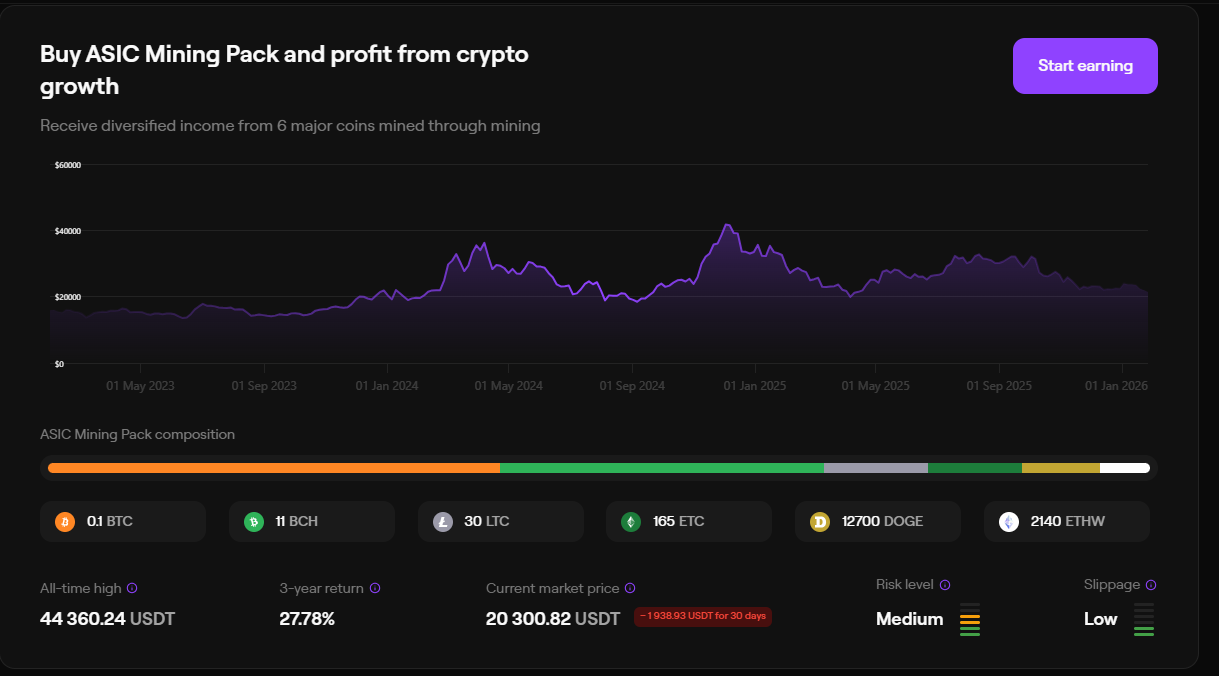
Consider using crypto indices, curated asset bundles based on specific themes. For instance, the EMCD ASIC Mining Pack combines six mining-related coins, offering diversified exposure to this sector without requiring deep research into each asset.
3. Assess Risk and Set Rules for Capital Allocation
Even top-performing assets can sharply decline. That's why capital allocation should be a calculated process, not improvisation, especially at the start of the year.
Guidelines for allocating capital in crypto:
- Define crypto’s percentage within your broader investment portfolio
- Limit exposure per asset to avoid overconcentration
- Establish exit rules (e.g., stop-loss, take-profit, trailing stop)
- Decide how to handle profits: withdraw to stablecoins or reinvest
Suggested rule: No more than 10% in any single coin, and no more than 50% in high-risk altcoins.
Example of profit allocation:
- 50% → move to stablecoins
- 30% → reinvest in long-term positions
- 20% → allocate to new opportunities
Well-defined rules help investors avoid common pitfalls like emotional trades or overreacting to market trends. This forms the foundation of long-term investment discipline.
4. How to Start Investing in Crypto in 2026: A Step-by-Step Guide
Many beginners delay investing simply because they don’t know where to begin. Fortunately, entering the crypto market is now more straightforward.
Step-by-step guide:
- Create a wallet:
- Custodial options (e.g., EMCD Wallet)
- Centralized exchange accounts (e.g., EMCD Exchange) - Secure your account:
- Enable two-factor authentication
- Back up your seed phrase offline - Fund your account:
- Use a card or
- Buy crypto via a P2P platform (e.g., EMCD P2P) - Buy your first coins:
- Start with BTC, ETH, or USDT
- Understand transaction fees and spreads - Explore investment platforms:
- Staking, lending, yield farming
- DeFi protocols, hybrid platforms
Basic rule: Never invest funds you’re not prepared to lose. This is a core principle of any responsible investment strategy.
5. Choose a Strategy: Passive, Active, or Hybrid
Deciding how to manage your portfolio is just as important as selecting assets. In crypto, you can take a passive, active, or hybrid approach. It’s worth identifying the best fit for your skill level, time commitment, and risk appetite.
Strategy comparison:
| Approach | Pros | Cons |
| Passive | Minimal effort, less stress | May miss short-term gains |
| Active | Potential for faster profits | High risk, time-intensive |
| Hybrid | Combines flexibility and stability | Requires discipline and planning |
For new investors, a passive strategy is often the most suitable starting point. It supports long-term thinking and reduces exposure to market noise. As experience grows, investors can gradually shift toward a hybrid model that can introduce more tactical elements like staking or selective trading.
6. Monitor the Market and Adjust Strategy When Needed
Even the most well-crafted strategy needs to evolve. The crypto market moves fast: New products launch, regulations shift, protocols update. Start the year with a habit of regularly reviewing your portfolio and adapting to new data.
Ongoing checklist:
- Monthly:
- Review asset performance
- Compare against market trends
- Adjust weights if needed - Quarterly:
- Rebalance portfolio
- Remove underperformers
- Add emerging opportunities - Continuously:
- Follow credible sources (e.g., Cointelegraph, Glassnode)
- Use tools like CoinStats, DeBank, or EMCD Monitoring
- Track project roadmaps
Adaptability is a strategic strength. In a fast-evolving sector like crypto, static allocations can become outdated within just a few months.
Looking ahead into the future
Crypto is a high-risk asset class, but with a disciplined approach, it can form part of a balanced portfolio and support strategic capital growth in 2026. The key is to act deliberately: set clear goals, decide how to allocate capital, define your crypto investment strategy for the year, study the market, and adjust when necessary.
FAQ
1. What should an investor do to reduce risk in crypto?
Investors should focus on diversification and risk management. This includes setting up a reserve fund, using secure wallets, and regularly reviewing their portfolio. It's also important to create a year-long plan and avoid impulsive decisions
2. How should capital be allocated in crypto at the early stage?
It’s best to distribute capital across three risk levels: core assets (e.g., BTC, ETH), promising altcoins, and experimental coins. Beginners should avoid putting more than 10% into a single asset and allocate a portion to stablecoins for safety
3. Why is having a year-long crypto investment strategy important?
A crypto investment strategy for the year helps avoid erratic decisions and stay aligned with long-term goals. It provides structure for allocating resources and enables timely adjustments based on market conditions
4. What should a beginner do before buying their first cryptocurrency?
New users should take a few initial steps: choose a secure platform, learn basic crypto operations, and assess their personal risk tolerance. It’s also helpful to draft a basic asset allocation plan and stay updated on key project developments
5. How often should capital allocation be reviewed?
It’s recommended to reassess how capital is distributed at least once per quarter. This allows for timely adjustments based on market shifts, removal of underperforming assets, and reinforcing positions in promising areas