




'%3e%3crect%20x='67.937'%20y='0.078125'%20width='15.0077'%20height='14.9965'%20rx='4.17731'%20fill='%23208F4E'/%3e%3crect%20x='67.8081'%20y='-0.21875'%20width='3'%20height='15'%20fill='%2363D793'/%3e%3cpath%20d='M78.5644%206.8781H76.1787L75.4418%204.60156L74.7026%206.8781L72.3169%206.87579L74.2489%208.28419L73.5097%2010.5584L75.4418%209.15232L77.3716%2010.5584L76.6347%208.28419L78.5644%206.8781Z'%20fill='%23111111'/%3e%3cpath%20d='M76.804%208.79613L76.6382%208.28125L75.4453%209.14938L76.804%208.79613Z'%20fill='%23111111'/%3e%3c/g%3e%3cdefs%3e%3cclipPath%20id='clip0_34823_22293'%3e%3crect%20x='67.937'%20y='0.078125'%20width='15.0077'%20height='14.9965'%20rx='4.17731'%20fill='white'/%3e%3c/clipPath%3e%3c/defs%3e%3c/svg%3e)







Crypto Cards with Apple Pay and Google Pay: How They Work in 2026
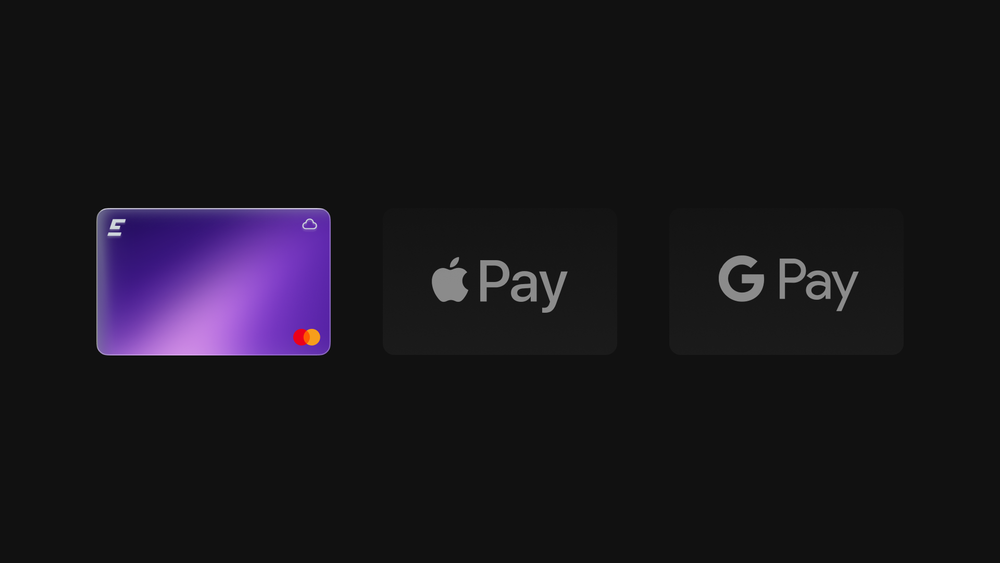

A crypto card with Apple Pay allows users to pay for everyday services using digital assets through familiar mobile wallets. In 2026, these cards are no longer experimental tools. They have become a practical payment layer that connects crypto platforms with real-world spending, without forcing users to manage blockchain transactions at checkout.
This article explains how crypto cards with Apple Pay and Google Pay work, which features actually matter, and how different card models compare, including platform-native solutions such as the EMCD Payment Card.
How crypto cards integrate with Apple Pay and Google Pay
Apple Pay and Google Pay do not store crypto. They function as secure interfaces that tokenize card details and forward payment requests to the card issuer. The crypto platform then verifies the balance, applies platform rules, and approves or declines the transaction.
A crypto debit card Google Pay setup works the same way as Apple Pay. The difference is not in the wallet itself, but in how the underlying crypto card is structured. Some cards are connected to exchange balances, while others are designed to operate strictly within a specific platform environment.
Virtual crypto cards and instant availability
Many users search for a crypto card instant virtual Apple Pay option. Virtual cards are issued digitally and can be added to Apple Pay or Google Pay without waiting for delivery. For most users, instant access is more practical than receiving a physical card.
A virtual card can be used for contactless payments, online purchases, and approved digital services. In many cases, activation is immediate, allowing payments shortly after issuance. A physical card may still be available for locations where mobile wallets are not accepted, but everyday usage is increasingly mobile-first.
Fees, foreign transactions, and what ‘no fee’ really means
Search terms like crypto card no foreign fee Apple Pay reflect common concerns about cross-border payments. In practice, fee structures vary between platforms. Some providers absorb foreign transaction costs, while others include them indirectly through exchange rates or network pricing.
Rather than relying on marketing claims, users should review fee disclosures carefully and understand how charges are applied in real transactions.
What defines the best crypto card with Apple Pay in 2026
When users look for the best crypto card Apple Pay 2026, they are usually comparing how cards work, not expecting one universal solution.
Key factors typically include:
- whether the card is virtual or physical
- which services and merchants are supported
- regional availability
- how deeply the card is integrated into a crypto platform
Some cards aim to mirror traditional banking, while others prioritize controlled payments within a defined ecosystem.
Platform-native cards vs. exchange-based cards
Most crypto cards fall into one of three models:
- exchange-linked cards tied to trading balances
- wallet-based cards designed for general merchant spending
- platform-native cards built for specific services
In a platform-native setup, the card functions as a debit payment instrument governed by platform rules rather than a traditional bank account. This model emphasizes predictability and clearly defined usage boundaries.
EMCD payment card and mobile wallets
The EMCD Payment Card works with Apple Pay and Google Pay as a built-in part of the EMCD platform, not as a standalone spending card. It lets users pay for supported services directly from their EMCD balance, without moving funds to exchanges or external wallets.
Instead of trying to cover every possible purchase, the card is designed for clear, predictable use inside the EMCD ecosystem. Payments are processed entirely within EMCD’s infrastructure, which means fewer intermediaries, transparent rules, and no guesswork around how crypto is used.
For active EMCD users, the card acts as a simple access layer to the platform. Crypto stays where it already works, and spending happens exactly where it makes sense.
Crypto cards with Apple Pay and Google Pay have become a practical interface between digital assets and everyday payments. However, the wallet layer is only part of the picture. Real functionality depends on the card model, platform rules, and supported use cases.
Some users prefer exchange-linked cards designed for general spending. Others benefit more from focused, platform-native solutions. For users already active within an ecosystem, a card like the EMCD Payment Card offers a more predictable and efficient way to use crypto, keeping funds inside the platform and removing unnecessary transfers.
Choosing the right crypto card ultimately comes down to how crypto is actually used — not how it is marketed.
without growing costs
cryptocurrencies