

USDT, USDC, and DAI Compared for Holding Funds

When crypto markets become volatile, many users move part of their funds into stablecoins to reduce direct exposure to large price swings. However, a US dollar peg does not make every stablecoin equally resilient under different market conditions. Reserve structure, issuer controls, reporting standards, liquidity, and depegging risk all matter, particularly during periods of market volatility.
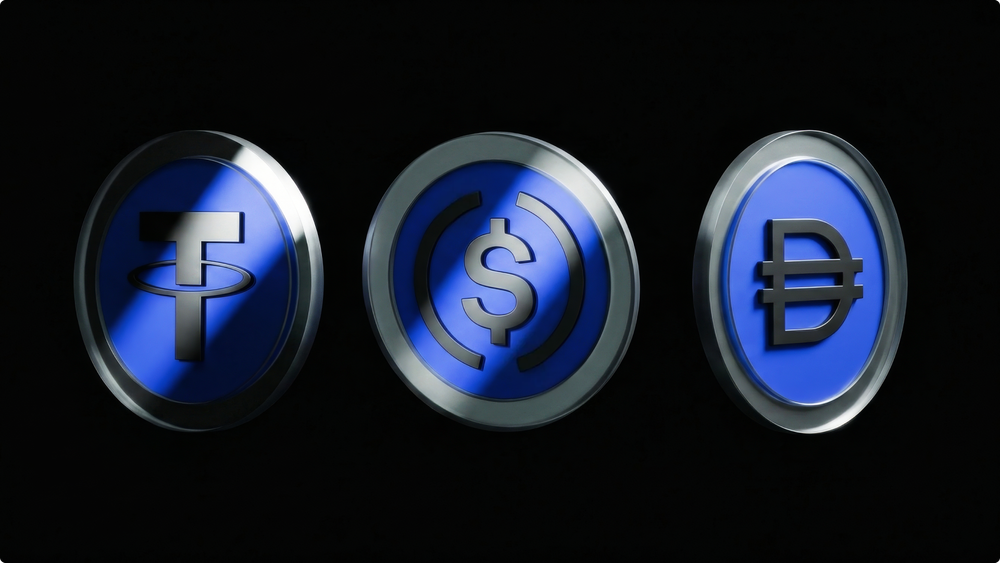
The choice between Tether (USDT), USD Coin (USDC), and Dai (DAI) is therefore less about selecting the most popular token and more about understanding how each one is structured. Liquidity may be the priority in one case, while reserve transparency, issuer exposure, or decentralized finance (DeFi) compatibility may matter more in another. These are some of the key differences that shape the broader comparison.
Key Takeaways
- Stablecoins serve a similar purpose but use different structures, so liquidity, reserve backing, issuer controls, and technical risks can vary significantly between USDT, USDC, and DAI
- USDT remains the largest stablecoin by market capitalization and combines broad market presence with widespread acceptance across P2P transfers, payments, supported networks, and crypto services
- USDC provides frequent reserve disclosures and monthly attestation reports, although the token remains dependent on its issuer and applicable legal and compliance requirements
- DAI uses protocol-based collateral and smart contracts rather than the same company-led reserve model as USDT or USDC, which makes its risk structure more complex for newcomers
What Stablecoins Are and How the Dollar Peg Works
Stablecoins are crypto assets designed to maintain a more stable price than most cryptocurrencies. The most common USD pegged stablecoins track the US dollar and are intended to remain close to $1. This makes them useful as a dollar-linked unit within the cryptocurrency market for holding funds, making payments, transferring value between services, or reducing exposure to more volatile assets.
Calling a token a stable asset does not mean its price is guaranteed to remain fixed. The basic idea appears straightforward: one token should remain worth approximately one US dollar. In practice, the peg depends on several moving parts, including reserve backing, issuer operations, market liquidity, issuance rules, and confidence in the structure behind the token.
How Stablecoins Maintain Their Dollar Peg
Different stablecoins use different mechanisms. USDT and USDC are examples of fiat backed stablecoins, where companies issue tokens and maintain reserves intended to support their value. These stablecoin issuers can hold cash, short-term instruments, US Treasury securities, and other assets as part of their reserve structures.
DAI works differently. Its stability depends on the collateral and risk-management structure of the broader protocol rather than on a conventional company maintaining a pool of dollar reserves. Its mechanics are closer to the logic associated with crypto backed stablecoins, although the protocol uses a broader collateral and governance structure.
How to Evaluate Stablecoin Reliability
A price close to $1 does not by itself demonstrate that a stablecoin can remain resilient. The more important question is what happens during periods of market stress. If concerns emerge around reserves, liquidity, protocol mechanics, or the issuer's ability to process redemptions, the token can temporarily trade below or above its intended peg.
When stablecoins are being considered for holding funds, several key factors deserve attention:
- Reserve backing: Whether the token relies on cash, short-term instruments, crypto assets, or a mixed collateral model
- Reporting: How frequently reserve information is disclosed and whether an independent party reviews the figures
- Liquidity: Whether the token can be converted in significant amounts without a large difference in price
- Infrastructure: Which blockchain networks, wallets, and crypto services support the asset
- Stress history: Whether previous depegging events occurred and how the token behaved while market confidence was under pressure
Market cap can indicate how widely a stablecoin is used, but it does not explain the quality of its backing or the risks built into its structure. A complete assessment also considers issuer controls and potential risks that may become more visible under stressed market conditions.
Stablecoins in Practice: Holding Funds, Transfers, and Defi
Stablecoins allow users to maintain a US dollar reference within the crypto market. Moving back into fiat currency is not necessary every time volatility increases, a transfer needs to be made, or funds need to move into another supported crypto asset.
In practice, stablecoin transactions can cover several different use cases:
- Hold part of available funds in a less volatile format during periods of sharp market movement
- Transfer value between wallets and crypto services, particularly when network transaction costs and availability matter, without relying on traditional remittance services for every transfer
- Settle business transactions and make stablecoin payments without direct exposure to sharp price movements in Bitcoin (BTC), Ethereum (ETH), or other volatile assets
- Interact with DeFi protocols, where USDT, USDC, and DAI can serve as base assets
- Move between crypto tools without returning to traditional finance or converting back into traditional fiat currencies after every operation
For businesses operating with crypto as well as individual users, infrastructure support can affect market access and the practical usability of a token. Wider adoption may increase the number of supported networks and services, but popularity should not be the only criterion when deciding where to keep dollar-linked value.
Stablecoins may look similar at the price level while relying on very different reserve, collateral, and governance structures. Those differences become clearer when USDT, USDC, and DAI are considered separately.
USDT: Liquidity, Reserve Structure, and Compliance Exposure
USDT is issued by Tether Limited and remains the largest stablecoin by market capitalization. Liquidity remains one of its main practical characteristics. The token has broad support across crypto services, is available on multiple blockchain networks, and appears across many trading pairs, P2P routes, and transfer options.
Current stablecoin market data continues to show USDT well ahead of USDC and DAI by market capitalization. Its higher market capitalization reflects its scale relative to the other tokens discussed here, although scale alone does not determine resilience.
Evaluating USDT also means examining how its reserves are structured, how much information is disclosed, and what assets support the tokens in circulation.
The latest available Tether reserve report covers June 30, 2026. It lists approximately $187.75 billion in reserve assets and $183.64 billion in liabilities, leaving about $4.11 billion in assets above liabilities. The reserve breakdown included approximately $114.96 billion in US Treasury bills, $18.63 billion in overnight reverse repurchase agreements, $18.84 billion in precious metals, and $5.80 billion in Bitcoin.
The disclosed breakdown therefore focuses on these reserve categories rather than corporate bonds. These figures provide more information about the structure behind Tether's treasury operations, but the total reserve amount is only one part of the assessment.
Asset liquidity, composition, reporting standards, counterparty exposure, and the ability to process redemptions under stressed market conditions also matter. These considerations are relevant to individual holders as well as institutional investors assessing the structure behind a stablecoin.
USDT's scale has another consequence. The same characteristics that support legitimate cross-border transfers, including broad availability and lower volatility than most crypto assets, also make stablecoins attractive for illicit activity. Analysis of 2025 activity found that stablecoins accounted for about 84% of identified illicit crypto transaction volume. At the same time, illicit transactions represented less than 1% of overall attributed crypto transaction volume, which is an important distinction when interpreting that figure.
This scale also brings greater regulatory scrutiny. Specific USDT addresses can be restricted in response to sanctions or law-enforcement requirements, so centralized issuer controls remain part of the token's regulatory risks. The practical implications depend on applicable regulatory requirements and the circumstances surrounding a particular address or transaction.
USDT therefore combines broad liquidity and infrastructure with issuer-level controls that should be considered when comparing different stablecoins.
USDC: Reserve Transparency, Us Compliance Requirements, and Issuer Control
USD Coin (USDC) remains the second-largest stablecoin by market capitalization. While USDT is generally stronger in overall liquidity and market reach, USDC's transparency is often considered through reserve disclosure, reporting standards, and the structure of the assets supporting the token.
Circle states that USDC is redeemable 1:1 for US dollars and backed by highly liquid cash and cash-equivalent assets. Reserve information is disclosed regularly, providing additional regulatory transparency around the structure used to support tokens in circulation.
As of August 27, 2026, Circle reported approximately $73.7 billion USDC in circulation and stated that reserve holdings equal or exceed the amount of USDC in circulation. The disclosed reserve categories include deposits at regulated financial institutions, overnight reverse Treasury repurchase agreements, and US Treasury securities with maturities below three months.
Several differences matter when comparing USDC with USDT:
- More frequent reserve disclosure: Circle provides regular information about USDC reserves and monthly third-party assurance reports
- Relatively straightforward reserve structure: Reserves primarily consist of cash and short-duration US Treasury-related instruments
- Greater exposure to issuer requirements: USDC operates within a company-led structure and is affected by financial regulations and applicable compliance requirements
- Lower liquidity than USDT: USDC has broad market support but remains considerably smaller than USDT by market capitalization
- Centralized controls remain: Circle can restrict addresses when required by sanctions, legal orders, or other applicable requirements
These controls make regulatory compliance part of the USDC structure rather than a separate consideration. Changes in the legal environment can also create regulatory challenges, while future regulatory developments may affect how issuer controls and access requirements are applied.
Neither structure automatically makes one token preferable in every situation. USDT generally offers deeper liquidity, while USDC provides a different balance of reserve disclosure and issuer oversight. For users prioritizing issuer reporting, that structure may provide greater regulatory clarity.
Dai: Decentralization, Smart Contracts, and Collateral Risk
Dai (DAI) differs from USDT and USDC because it does not follow the same conventional model of a company issuing tokens against a portfolio of dollar-denominated reserves. DAI operates through protocol mechanics involving collateral, smart contracts, vaults, and governance-defined risk parameters.
The surrounding protocol has also changed. Maker was rebranded as Sky in 2024, and USD Sky Dollar (USDS) is now positioned as the upgraded version of DAI within Sky Protocol. This was a significant development in the protocol's structure, although DAI remains available as the broader system increasingly uses USDS as its primary stablecoin.
For experienced DeFi participants, the structure may reduce reliance on one traditional issuer and provide greater onchain visibility into protocol activity. However, decentralization does not remove risk. The system still depends on collateral quality, smart-contract integrity, governance decisions, market liquidity, and external DeFi infrastructure.
Sharp market movements can reduce collateral value and trigger automated liquidations or changes to protocol parameters. This makes DAI more difficult to evaluate than a simple fiat-backed model, particularly for users without prior experience with DeFi.
DAI can therefore serve a different role from USDT or USDC. Its structure may appeal to users who specifically need DeFi functionality, but understanding the token requires more than checking whether its market price remains close to $1.
Algorithmic Stablecoins: Why They Are Harder for Beginners to Evaluate
Algorithmic stablecoins rely heavily on code, token issuance mechanics, incentives, and market confidence to maintain their target price. Unlike straightforward reserve-backed models, they may not have a simple pool of cash or short-term assets supporting every token.
Their structure is also different from commodity backed stablecoins, where the underlying backing model follows another type of reserve framework. The comparison here focuses on dollar-linked and collateral-based models rather than those alternatives.
TerraUSD (UST) remains the best-known example of what can happen when this structure breaks down. Its $1 peg relied on a mechanism connected to LUNA. When confidence deteriorated and holders began exiting UST at scale, LUNA's price collapsed and the stabilization mechanism could no longer absorb the pressure. UST subsequently lost its dollar peg.
Several characteristics make algorithmic stablecoins particularly difficult for newcomers to assess:
- Reserve backing may be difficult to evaluate: Some algorithmic models do not rely on straightforward dollar reserves or short-term instruments
- Market confidence plays a major role: Rapid selling can place additional pressure on the mechanism intended to maintain the peg
- The mechanics are complex: Evaluating the model can require an understanding of smart contracts, token issuance, incentives, and market behavior
- Depegging can accelerate quickly: During severe market stress, the price can move away from $1 before the underlying mechanism has time to restore balance
For a first comparison within the broader stablecoin landscape, USDT, USDC, and DAI provide more established structures to examine. Algorithmic models require an additional layer of technical and market-risk analysis.
FAQ
Which stablecoin is more reliable for holding funds?
There is no universal answer because each stablecoin has a different risk structure. USDT is stronger in liquidity, USDC provides more frequent reserve reporting, while DAI requires a deeper understanding of collateral and DeFi protocol mechanics.
What is better for holding funds: USDT or USDC?
USDT may be more practical when broad network support, P2P activity, and liquidity are priorities. USDC may be better suited to users who place greater weight on reserve disclosures and a more straightforward reserve structure. Some users also divide funds between several stablecoins rather than relying on one issuer.
Why are algorithmic stablecoins harder for beginners?
Algorithmic stablecoins can depend on token incentives, smart contracts, market confidence, and automated stabilization mechanisms rather than straightforward reserves. The collapse of UST demonstrated how quickly such a structure can fail when confidence and market liquidity deteriorate.
Stablecoins Without Assumptions: There Is No Universal Choice
There is no single winner among USDT, USDC, and DAI. USDT has the deepest liquidity and broad support for transfers and P2P activity, while its reserve structure and centralized issuer controls remain relevant considerations. USDC provides frequent reserve reporting and a relatively straightforward backing model, but it also depends on Circle and the legal requirements that apply to the issuer. DAI follows a different model built around collateral, smart contracts, and protocol governance, which makes it more closely connected to DeFi but also more complex to evaluate.
The appropriate choice therefore depends on the intended use. USDT is generally stronger where liquidity and broad infrastructure matter, USDC places greater emphasis on reserve disclosure, and DAI serves a more protocol-oriented DeFi use case.
without growing costs
cryptocurrencies