


'%3e%3crect%20x='67.937'%20y='0.078125'%20width='15.0077'%20height='14.9965'%20rx='4.17731'%20fill='%23208F4E'/%3e%3crect%20x='67.8081'%20y='-0.21875'%20width='3'%20height='15'%20fill='%2363D793'/%3e%3cpath%20d='M78.5644%206.8781H76.1787L75.4418%204.60156L74.7026%206.8781L72.3169%206.87579L74.2489%208.28419L73.5097%2010.5584L75.4418%209.15232L77.3716%2010.5584L76.6347%208.28419L78.5644%206.8781Z'%20fill='%23111111'/%3e%3cpath%20d='M76.804%208.79613L76.6382%208.28125L75.4453%209.14938L76.804%208.79613Z'%20fill='%23111111'/%3e%3c/g%3e%3cdefs%3e%3cclipPath%20id='clip0_34823_22293'%3e%3crect%20x='67.937'%20y='0.078125'%20width='15.0077'%20height='14.9965'%20rx='4.17731'%20fill='white'/%3e%3c/clipPath%3e%3c/defs%3e%3c/svg%3e)






IOTA Cryptocurrency — Overview, Technology, and Forecast
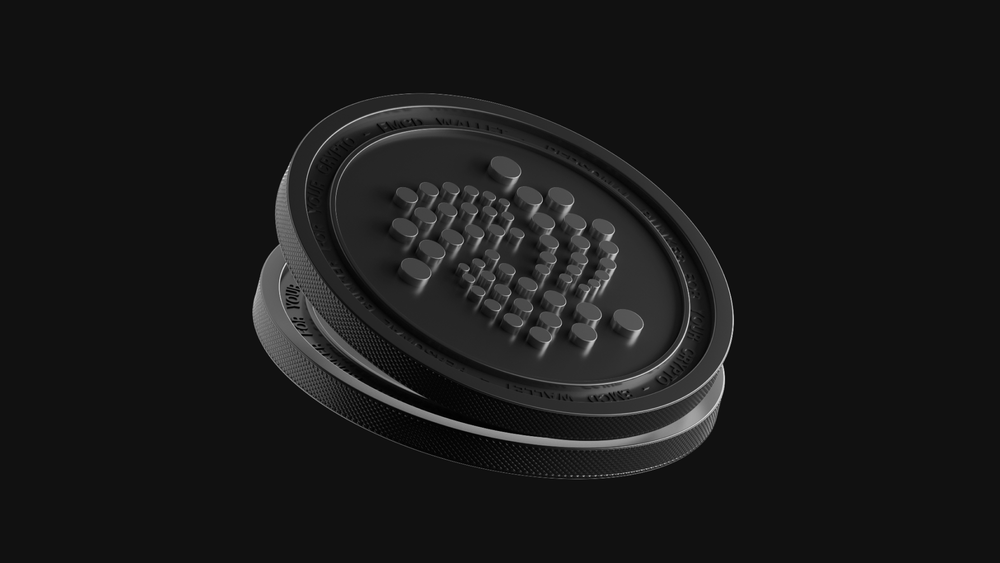

IOTA is a cryptocurrency with a unique architecture designed for machine-to-machine interaction within the Internet of Things (IoT). Unlike traditional blockchains, the project positions itself as a solution for scalable and high-throughput microtransactions between devices. Below is a detailed overview of the IOTA network, its current market position, and key aspects of its outlook.
What Is IOTA?
IOTA (often pronounced ‘eye-oh-tah’) is a decentralized cryptocurrency and distributed ledger based on Directed Acyclic Graph (DAG) technology rather than a conventional blockchain structure. The core idea is to create a network where devices can exchange data and value without transaction fees and with high throughput.
The project’s architecture is called the Tangle. In this system, each transaction confirms two previous transactions, making the network structure more scalable than conventional blockchains. The project was founded in 2016 by David Sønstebø, Sergey Ivancheglo, Dominik Schiener, and Sergey Popov.
How the Network Works
Unlike Proof-of-Work (PoW) or Proof-of-Stake (PoS) blockchains, IOTA does not rely on miners. New transactions are added to the network by users, who simultaneously validate previous transactions. This system eliminates transaction fees, increases throughput, and reduces computational requirements.
This design makes IOTA particularly suitable for automated micropayment scenarios, where large volumes of data and payments are exchanged between machines without human involvement.
Market and Current Data
As of 2026, IOTA is trading significantly below its all-time high of around $5.25, recorded in 2017.
According to aggregated market data, the current price fluctuates between approximately $0.07 and $0.09, with a market capitalization ranging from about $300 million to $430 million, depending on the platform. The total token supply is approximately 2.78 billion IOTA, which influences price dynamics and market capitalization compared to assets with a smaller circulating supply.
IOTA Forecast: Short-Term and Mid-Term
Price forecasts for IOTA often vary among analysts. Some analytical models outline potential short-term price ranges, for example between $0.056 and $0.114 in 2026.
In the mid-term, expanding integrations and ecosystem partnerships could contribute to greater price stability in the coming years. However, significant growth may be difficult without supportive conditions in the broader digital asset market.
Long-Term IOTA Forecast
The long-term outlook for IOTA remains uncertain to moderate. The project is focused on building infrastructure for the Internet of Things rather than prioritizing short-term price appreciation. Its long-term potential depends on wider adoption of Tangle technology, the expansion of partnerships, and the platform’s ability to secure real-world use cases in IoT and smart devices.
At the same time, analysts generally do not anticipate substantial upside without broader market momentum.
Key Influencing Factors
Several key factors may influence the price of IOTA:
- Ongoing development and upgrades of Tangle technology
- Expansion of partnerships and ecosystem integrations
- News and trends in the IoT and cryptocurrency sectors
- Regulatory changes and exchange decisions regarding token listings
It is important to distinguish meaningful developments from market noise: not every news event automatically leads to asset appreciation.
IOTA is an unconventional distributed ledger platform built on a unique architecture designed for the Internet of Things. The project has evolved over many years and continues to define its place within the digital asset ecosystem. The IOTA outlook remains uncertain: some models suggest moderate expansion, while others indicate a more restrained trajectory or prolonged consolidation. When viewed as a technological platform, IOTA presents an interesting infrastructure concept; however, participation in digital asset markets requires careful evaluation and a clear understanding of associated risks.
without growing costs
cryptocurrencies