


Bitcoin's Long Road from a New Record to a Deep Correction


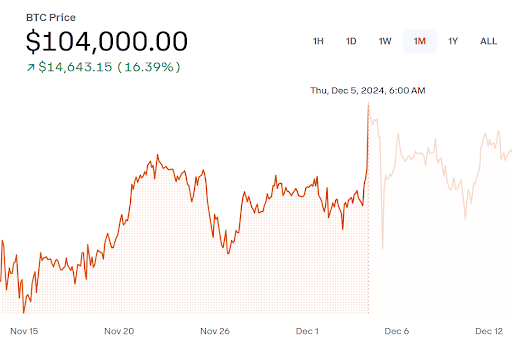
On December 5, 2024, Bitcoin hit what was then an all-time high, reaching $104,000 — a sharp surge after a period of relative calm. The leading cryptocurrency's market capitalization also set a new record, surpassing $1.9 trillion.
Bitcoin repeatedly broke records throughout November 2024, dipping and rebounding along the way. But as later events showed, that December 2024 milestone turned out to be just an intermediate point in a much longer story — the market still had a far higher peak ahead of it, followed by a significant correction. Let's break down what drove the rally back then, and what's happened to Bitcoin since.
The US Election: A Catalyst for Bitcoin's Rise
The United States held its presidential election on November 5, 2024. Shortly after, Bitcoin set a new all-time high — for the first time ever, its price exceeded $90,000, rising by roughly a third in the week following the election.
Analysts widely pointed to Donald Trump's victory as the primary driver, given his outspoken support for cryptocurrency and his campaign promise to make the US a "Bitcoin superpower." The Republican Party's success in congressional races gave Trump more direct influence over crypto policy going forward.
Analysts also cited several less obvious contributing factors: the launch of spot Bitcoin ETF trading in the US, Federal Reserve interest rate cuts, the April 2024 halving, and growing investor uncertainty about the dollar's status as a reserve currency.
What Happened to Trump's Promises: The Strategic Reserve Becomes Reality
At the end of 2024, Trump's promise to create a national Bitcoin reserve was still a hypothetical scenario. Since then, it's become reality: on March 6, 2025, the president signed an executive order establishing the US Strategic Bitcoin Reserve. It initially consisted of roughly 200,000 BTC seized through criminal and civil forfeiture proceedings, with a rule prohibiting the sale of those coins — the reserve is treated as a long-term national asset, managed by the Treasury Department.
By February 2026, US government Bitcoin holdings had grown to roughly 328,372 coins. However, two bills meant to codify the reserve's status into law — the BITCOIN Act and the American Reserve Modernization Act — remain unpassed by Congress, and ongoing disagreements between the Treasury and Commerce Departments over asset custody persist. As a result, as of mid-2026 the reserve still hasn't been fully operationalized, despite formally existing for over a year.
How Bitcoin's Price Moved: From December 2024 to August 2026
The December 2024 record of $104,000 wasn't the ceiling. The rally continued, and in October 2025 Bitcoin reached its real all-time high — around $126,000. A prolonged correction followed: by mid-August 2026, Bitcoin's price had fallen to roughly $63,000–$65,000, down by about half from its peak.
A similar pattern played out across other major cryptocurrencies: Ethereum, which climbed to $4,096 in December 2024, later set its own record around $5,000 (August 2025), but had also corrected to roughly $1,900 by mid-2026.
How This Has Affected the Crypto Market
Bitcoin remains the market's leader and primary trendsetter — the rest of the crypto market still largely follows its movements, though the correlation isn't absolute and varies by asset and news environment.
Is Now a Good Time to Invest?
The experience of 2024–2026 makes one thing clear: confident predictions about Bitcoin's future price movement don't hold up well. In under two years, the market saw the price roughly double, hit a new all-time high, and then correct by nearly 50%. Where it goes from here depends on a range of factors — how quickly the Strategic Reserve becomes fully operational, Federal Reserve rate decisions, the broader regulatory environment, and investor sentiment.
It's worth remembering: cryptocurrency is a highly volatile asset, and any investment decision is ultimately yours to make. Weigh the risks realistically, and never invest more than you're prepared to lose.
FAQ
What is Bitcoin's current all-time high?
Bitcoin's all-time high was set in October 2025 at around $126,000. The December 2024 record of $104,000, widely reported at the time, turned out to be just an intermediate step on the way to that peak.
What is the US Strategic Bitcoin Reserve, and how does it work?
It's a US government Bitcoin reserve established by executive order in March 2025. It consists of coins seized through criminal and civil forfeiture; selling them is prohibited, and the reserve is treated as a long-term national asset, similar to a gold reserve.
Why hasn't the reserve become fully operational, despite existing for over a year?
The main reason is legislative and inter-agency uncertainty: key bills defining the reserve's legal status haven't passed Congress, and there are ongoing disagreements between relevant agencies over control of the assets.
Why did Bitcoin's price fall by nearly half after its 2025 peak?
A correction following a sharp rally is a common pattern in crypto markets. The decline reflected a combination of factors: profit-taking after the all-time high, shifts in monetary policy, and a broader pullback of speculative capital from risk assets.
How did the US presidential election affect Bitcoin's price in 2024?
Donald Trump's victory was widely seen by the market as a signal of friendlier crypto regulation ahead, which drove a sharp rally immediately after the election. That expectation was later partly borne out through concrete policy steps, including the creation of the Strategic Bitcoin Reserve.
Should you invest in Bitcoin given its volatility?
There's no single right answer — it depends on your risk tolerance and investment horizon. The 2024–2026 period shows that even during a broader uptrend, the market can experience sharp corrections of tens of percent, so any decision should be based on a realistic assessment of your own ability to withstand that kind of swing.
without growing costs
cryptocurrencies